
2020-2021 Spending the winter in a class C RV — when I learned he couldn’t be left alone.
Summer 2020: Finding a comrade
After getting home in 2020, that’s when I started conversing with Barbara. I met Barbara through a Facebook group on dementia caregiving. I was looking for people to chat with outside of the traditional posting because I think it’s not easy to really let it all hang out and get the help and support you really need. She is still my pen pal, old enough to be my mother and young enough to be my friend.
Choosing the RV for Chasing the Sun
In June, we looked for and bought a Class C RV, planning to go to Arizona and boondock the following winter (which we did). But Uno had two cataract surgeries and a retinal tear, so we did not take the fall trip we planned on. And then the doctor didn’t want him driving, so I did all the driving in a 29‑ft RV. It really was ok; easier than a trailer. Such an easy decision to boondock; the isolation of Covid meant people left you alone.
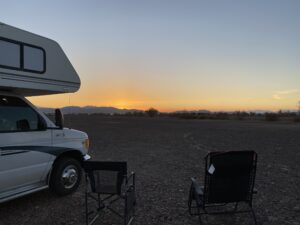
We were chasing the sun, but inside that 29‑foot RV, everything felt different. It looked like a winter getaway from the outside, but it wasn’t a vacation. Not really. There was so much inner turmoil — the kind you don’t post about, the kind you barely admit to yourself.
South for the Winter
We actually drove the RV to his last retinal follow‑up appointment around December 28. Then we drove down to Illinois to caravan to Arizona with my brother. I felt safer that way. We took 3–4 days, traveling about 400–500 miles a day. We decided to go down around the horn of Texas
to avoid a snowstorm and ended up right in the middle of one. We ran the RV all night to stay warm because the generator wouldn’t start after the first night. Turns out it froze up as I hadn’t gotten around to checking its oil (last thing on my list). I also had taken too much stuff—the RV was a bit overloaded because I was afraid of not getting to stores. Turns out we camped with people who would take us to the grocery, as would our e-bikes in a pinch.
We spent New Year’s Eve at a gas station in Gila Bend, AZ, then went on to Welton near Yuma. After a few days in Yuma we spent three great weeks in Quartzsite, then on to Wickenburg for six weeks. We finished our time boondocking in Arizona in Gold Canyon for a week or so.
Working at Dawn, Caregiving All Day
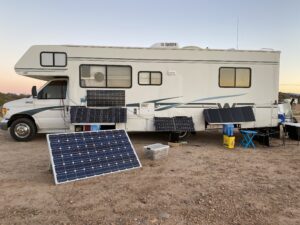
I was working remotely full time, would work every morning from 6–2 or, when daylight savings came, from 5–1. It was dark and a bit cold at 5 in the morning as I climbed into the living room area and turned on my two computer monitors, plugged into my laptop and solar‑powered battery banks. During the day we’d set the solar to track the sun.
Understanding the Development Age
My husband would sit in the camper while I worked. Or sit outside and enjoy the sun. Or go for a walk with Kathy, with whom we were camping. Or do the dishes outside. When you boondock, you try not to use your water tanks, so we would heat up water, wash the dishes in tubs outside the rig, and toss the water on a tree. Desert trees were glad for that.
Except he wouldn’t heat the water. Oh, I would get mad. I didn’t quite understand. Then Kathy helped me realize that my husband’s development age was changing. He was probably capable of doing things that a young child would do—and love playing with water. “Let him,” she said. I could rewash the dishes when he wasn’t looking. I didn’t learn that lesson right away. I shake my head as I write it now.
He Couldn’t Be Left Alone Anymore
One time, he walked off alone. He left a note: “You have your family, I have no one.” Though that wasn’t true, that was his perception. I tried to be more aware of including him, even in things that might be hard. He would go to bed early, so I would make sure he was settled, then go have my adult time watching TV, sometimes enjoying wine, and visiting with my brother and our friend Kathy. I remember more than once falling apart and crying by my brother. I didn’t really know what was wrong. Now I know it was the stress of the situation affecting my health, my ability to function. I continued as best I could.
He was definitely starting not to be left alone. He made bad decisions if alone. I started watching the cycle: Alone → look for something to do → do it wrong → get frustrated → do it dangerously → get in trouble. I’d get mad if he ruined something. So it got easier to police, patrol, and get someone to watch him. By the time we got home in late April, I started to line up caregivers to be with him during my working hours. The VA covered some of that and I covered the rest. Life was definitely changing.
My creative voice was so quiet during this time. I could hardly make sense of the season, let alone talk or sing about it. It would be months before I could finally let it out with “I’ll Go On,” as I began to turn my anger into compassion.
At the time, even people close to us didn’t always understand what was happening. Some thought he was exaggerating or just making things harder than they needed to be. It took a while before others could see what I was seeing — that he truly wasn’t able to do things the way he used to. This was one more layer to an already changing landscape full of potholes.
Spring arrived, and the vacation that wasn’t a vacation took us 2000 miles back home over a few days – one 900 mile day of driving to outrun an ice storm.
Whispers of Retirement
There was an awareness that I couldn’t keep this up much longer. I planned on retiring that year—but I was in the middle of a big project. I had to decide how to make the transition. I knew I needed to.
* * * *
To read more about the Story Behind the Song, “I’ll Go On,” you can visit that blog here.
#InspirationalCaregiving
© Jodi Bloom, September 2026